


1. What Is a Three-Phase Hybrid PV Inverter?
A hybrid PV inverter is a single piece of power-conversion equipment that combines three functions normally handled by separate devices: a solar (PV) inverter, a battery inverter/charger, and an automatic transfer switch. Instead of wiring a grid-tie inverter, a separate battery charger, and a backup transfer switch, a hybrid unit manages solar generation, battery charging and discharging, and grid interaction from one enclosure.
Three-phase hybrid inverters — as opposed to single-phase units — are designed for installations where the building's electrical service is three-phase, which is typical for larger residential properties, light industrial facilities, farms, workshops, and commercial buildings. Balancing load and generation across three phases reduces neutral current, improves voltage stability, and allows a single inverter to support much higher continuous loads than a single-phase equivalent of similar cost.
2. About the Manufacturer: Zhejiang Sunohoo Technology
The HS3150EH48L is manufactured by Zhejiang Sunohoo Technology Co., Ltd, a China-based manufacturer specializing in PV inverters and energy storage systems, including portable power stations, household energy storage systems, energy storage batteries, and industrial & commercial energy storage systems.
The company documents its in-house engineering capability on its Technology page, which covers R&D capabilities, university cooperation, and factory workshop/equipment standards, and it publishes product certifications on the Certification section of its About page. This kind of documented manufacturing process and third-party certification is a useful signal for installers evaluating supplier trustworthiness — beyond the datasheet numbers, it indicates the equipment is designed and tested against recognized standards rather than assembled without formal quality control.
For procurement teams performing supplier due diligence, Sunohoo's Industry News and Company News sections provide ongoing updates on product releases and market activity, while the FAQ and Contact pages outline pre-sales and after-sales support channels.
3. HS3150EH48L Product Overview
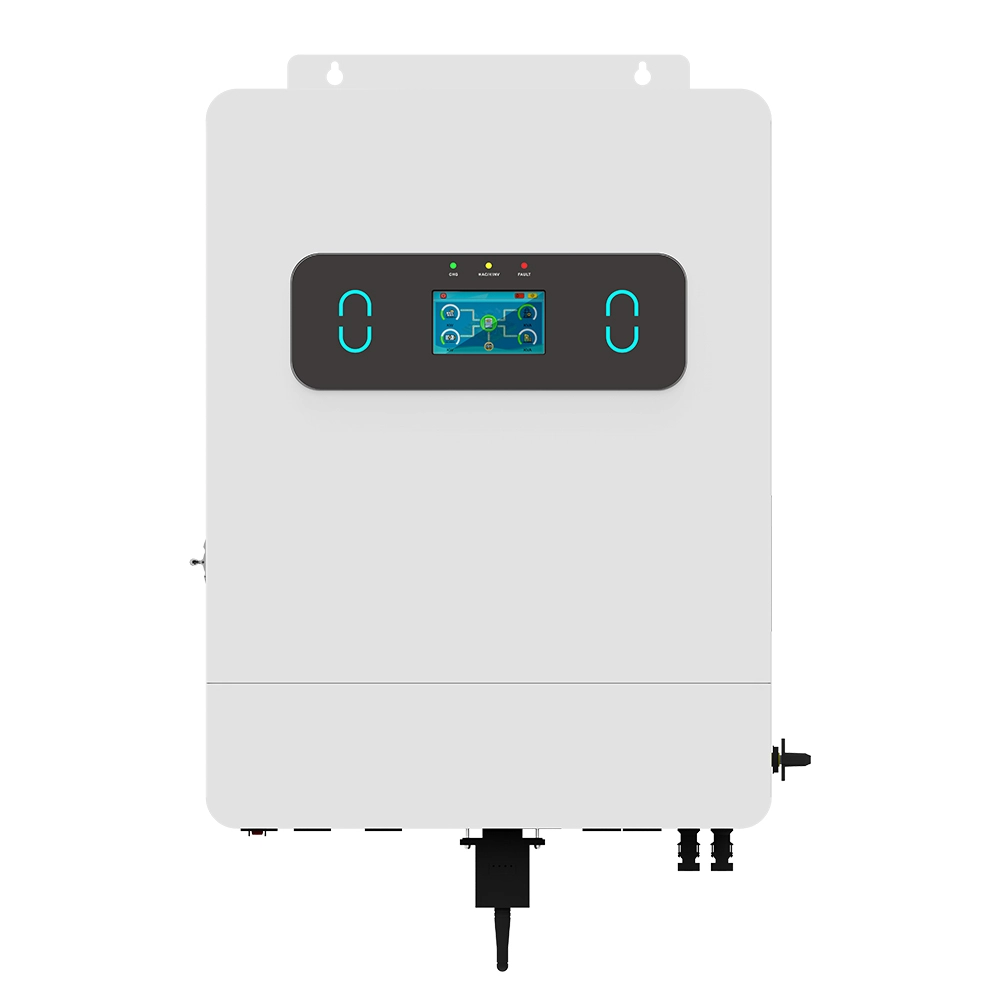
HS3150EH48L three-phase hybrid inverter. Image source: Zhejiang Sunohoo Technology Co., Ltd.
The HS3150EH48L belongs to Sunohoo's HS series of three-phase hybrid inverters and is built around a 48 Vdc battery bus with a 15,000 W (15 kW) rated output power. It is designed to operate in grid-tied, off-grid, and grid-interactive (backup) modes, and it can run without a battery connected by drawing simultaneously from PV and grid input — a configuration useful for phased installations where batteries are added later.
The unit is wall-mounted, weighs 24 kg, and measures 478 × 140 × 625 mm, making it suitable for indoor installation in utility rooms, plant rooms, or dedicated equipment enclosures on commercial and light-industrial sites.
4. Core Technical Highlights
4.1 Reliable performance under real-world loads
Both the battery side and load side are rated for high surge capacity with smooth voltage and current waveforms, allowing the inverter to start and drive inductive loads such as air-conditioning compressors without derating the connected load. The independent, intelligent load/generator interface is compatible with existing PV systems and permits operation without a battery installed, running purely on combined PV and grid power. If the battery is absent or depleted, the unit can bypass to grid output so that critical loads remain powered, while the grid-connected export function keeps unused solar generation economically productive rather than curtailed.
The inverter supports grid-tied, off-grid, and automatic grid-tied/off-grid switching modes, with adaptive output frequency and configurable time-of-use charge/discharge strategies, letting the system shift battery cycling to match utility tariff schedules.
4.2 Economic benefits from PV oversizing
With two independent MPPT channels, the DC input can be sized at 1.2–1.5× the inverter's rated AC output, so installers can oversize the PV array relative to the inverter's nameplate rating. This increases energy harvest during low-light, early-morning, and late-afternoon periods without increasing the cost of the inverter itself, while the unit still supports simultaneous full-power charging and load supply.
4.3 Friendly, field-serviceable design
A high-definition touchscreen with multi-language support simplifies commissioning and diagnostics. A removable dust cover is provided for harsher installation environments, AC output voltage standards can be reconfigured to match regional grid codes, and a battery activation function helps recover deeply discharged battery banks.
4.4 Comprehensive protection suite
The HS3150EH48L includes AICOT (active islanding detection and protection), PV reverse-polarity alarm, external CT (current transformer) reverse-connection alarm and open-circuit detection, three-phase independent anti-backflow protection, three-phase phase-sequence detection, and zero/ground fault detection — a protection set aimed at the specific failure modes seen on three-phase commercial installations.
5. Full Technical Specification Table
| Parameter | HS3150EH48L |
|---|---|
| Battery | |
| Battery Voltage | 48 Vdc |
| Battery Type | Lead-acid, lithium, gel, and similar chemistries |
| Battery Voltage Range | 40–60 Vdc |
| Battery Max Charging Current | 260 ± 5 A |
| AC Output | |
| Rated Output Power | 15,000 W |
| Rated Output Voltage | 220/380 Vac ±4%, 230/400 Vac ±4% |
| Rated Output Frequency | 50/60 Hz, intelligent adaptive / configurable |
| Output Waveform | Pure sine wave |
| Max Efficiency (Peak) | 92% |
| Rated Current | 21.7 A |
| Transfer Time | 10 ms (typical) |
| Parallel Function | N/A |
| PV Input | |
| Max PV Power | 20,000 W |
| MPPT Voltage Range | 90–800 Vdc |
| Max Input Voltage | 800 Vdc |
| Max Charging Current (PV) | 260 ± 5 A |
| Number of MPPT / Strings per MPPT | 2 / 1+1 |
| Mains / Generator Input | |
| Max Charging Current | 120 ± 5 A |
| AC Input Voltage Range (UPS mode) | Phase voltage 170–280 Vac; line voltage 305–485 Vac |
| Rated Frequency | 50 / 60 Hz |
| General | |
| Dimensions (W×D×H) | 478 × 140 × 625 mm |
| Installation Method | Wall-mounted |
| Weight | 24 kg |
| Communication | RS485 / CAN; optional WiFi / 4G |
| Operating Ambient Temperature | -25°C to 60°C (derating above 45°C) |
| Storage Temperature | -20°C to 60°C |
| Humidity | 5%–95%, non-condensing |
| Altitude | 4000 m (derating above 2000 m) |
| Installation Environment | Indoor use only |
Source: official HS3150EH48L product page and specification PDF, Zhejiang Sunohoo Technology Co., Ltd. Values may be revised by the manufacturer; confirm against the current datasheet before specifying a project.
6. PV Input & Dual-MPPT Design Explained
The HS3150EH48L has two independent MPPT (Maximum Power Point Tracking) channels, each of which can accept one or two strings (1+1 configuration per channel). The MPPT voltage window is 90–800 Vdc with a hard input ceiling of 800 Vdc, which gives designers flexibility in string length depending on module voltage and local temperature-derating rules.
Because the maximum PV input power (20,000 W) exceeds the rated AC output (15,000 W), the array can be oversized to roughly 1.2–1.5× the inverter's nameplate rating, a common strategy for maximizing annual energy yield relative to inverter cost — commonly referred to in the industry as the "DC/AC ratio" or "ILR" (inverter loading ratio). A higher DC/AC ratio increases production during off-peak sun hours at the cost of some clipping around solar noon, and the 20 kW ceiling on this unit defines the practical upper bound for that trade-off.
| PV Design Parameter | Value | Design Implication |
|---|---|---|
| Rated AC Output | 15,000 W | Baseline for sizing continuous loads and utility interconnection. |
| Max PV Power | 20,000 W | Upper ceiling for total installed array capacity (≈1.33× rated output). |
| MPPT Channels | 2 | Supports two roof orientations or shading zones independently. |
| MPPT Voltage Range | 90–800 Vdc | Wide window accommodates varying string lengths and module types. |
7. Application Scenarios
Given its three-phase output, 15 kW rating, and 48 V battery bus, the HS3150EH48L is generally suited to installations that fall between large residential and light commercial scale. Typical scenarios include:
Large residential / villa properties on a three-phase supply, where balanced loads and higher continuous power draw (e.g., electric vehicle charging, heat pumps, workshops) exceed single-phase inverter capacity.
Small commercial and retail premises seeking to reduce demand charges and grid dependency through self-consumption and time-of-use arbitrage.
Agricultural and light-industrial sites that need to start inductive loads (pumps, compressors, air conditioning) reliably from stored or solar power.
Backup power / energy resilience projects in areas with unstable grid supply, using the automatic grid-tied/off-grid switching mode and bypass function to keep critical circuits energized.
A broader view of Sunohoo's supported use cases is available on the company's Applications page, and the same 48 V hybrid platform is offered across a family of power ratings — see the comparison section below.
8. How It Compares to Other Sunohoo Hybrid Inverters
The HS3150EH48L sits within a wider HS/HC/HB product family. The table below summarizes how it relates to adjacent models referenced on the manufacturer's site, to help narrow down the right power class and phase configuration for a given project. Always confirm current specifications on the linked product pages, since manufacturers periodically update ratings.
| Model Series | Phase Configuration | Typical Use Case |
|---|---|---|
| HS3150EH48L (this model) | Three-phase, 15 kW | Larger residential / light commercial three-phase installations |
| HS3085EH48L ~ HS3150EH48L series | Three-phase, 8.5–15 kW range | Scalable three-phase family for varying load sizes |
| HS2085UH48L ~ HS2120UH48L | Split/single-phase family | Properties on single-phase or split-phase utility service |
| HS1120EH48L ~ HS1150EH48L | Single-phase, entry power class | Standard residential installations |
| HS1085EH48L | Single-phase hybrid | Smaller residential or budget-focused installations |
For pairing with a battery bank or a full turnkey system, review the Energy Storage Battery and Household Energy Storage System product lines from the same manufacturer.
9. Protection Functions & Safety Design
Three-phase systems introduce failure modes that single-phase equipment does not need to address — phase-sequence errors, unbalanced backfeed between phases, and multi-string PV wiring mistakes among them. The HS3150EH48L's protection suite is built specifically around these risks:
| Protection Function | What It Guards Against |
|---|---|
| AICOT islanding protection | Inverter continuing to energize a de-energized grid line, a hazard to utility line workers. |
| PV reverse-connection alarm | Reversed polarity wiring on PV strings during installation. |
| External CT reverse-connection alarm / open-circuit detection | Incorrect current-transformer wiring, which can cause inaccurate metering or unsafe operation. |
| Three-phase independent anti-backflow | Unwanted power export on phases where export is restricted or not permitted. |
| Three-phase phase-sequence detection | Incorrect phase rotation, which can damage connected three-phase motors. |
| Zero/ground detection | Neutral-to-ground faults and unsafe grounding conditions. |
| Over/under voltage & frequency protection | Abnormal grid conditions outside the configured operating window. |
| AC output short-circuit / overload protection | Downstream wiring faults or load beyond rated capacity. |
| High/low temperature protection | Thermal stress in high-ambient or poorly ventilated installation locations. |
10. Certifications & Compliance Standards
The unit is listed with CE and RoHS marking, and is tested against a set of IEC/EN standards covering electromagnetic compatibility, grid-connection behavior, and inverter safety:
| Standard | Scope |
|---|---|
| IEC/EN 61000-6-1 / 6-3 | Electromagnetic compatibility — generic immunity and emission standards. |
| IEC/EN 61000-3-11 / 3-12 | Limits on voltage fluctuation, flicker, and harmonic current for equipment connected to public low-voltage systems. |
| EN 62920 | EMC requirements specific to power conversion equipment used in photovoltaic systems. |
| IEC 62109-1 / 62109-2 | Safety of power converters for use in photovoltaic power systems — general and inverter-specific requirements. |
| IEC 62321 | Determination of restricted substances (e.g., lead, mercury) in electrotechnical products, supporting RoHS compliance. |
Standards are maintained by the International Electrotechnical Commission (IEC). Confirm the certificate scope and test reports directly with the manufacturer for the country of installation, since certification coverage can vary by model variant and export market.
11. Frequently Asked Questions
Can the HS3150EH48L operate without a battery installed?
Yes. The independent load/generator interface allows the inverter to run on combined PV and grid power without a battery connected, which is useful for staged installations where storage is added later.
What battery chemistries are supported?
The datasheet lists compatibility with lead-acid, lithium, and gel batteries, operating within a 40–60 Vdc battery voltage window on a 48 V nominal bus.
How much PV can be connected?
Up to 20,000 W across two MPPT channels (each supporting 1+1 strings), against a 15,000 W rated AC output — an oversizing ratio of roughly 1.2–1.5×.
Is this inverter suitable for outdoor installation?
No. The manufacturer specifies indoor use only, so the installation location must be a sheltered space such as a utility or plant room.
Does it support parallel operation with other units?
According to the published specification, parallel function is listed as not applicable (N/A) for this model.
12. Conclusion & Next Steps
The HS3150EH48L targets the space between residential and light-commercial three-phase energy storage: a 15 kW continuous rating, dual-MPPT PV input capable of significant oversizing, and a protection suite built specifically for three-phase backfeed and phase-sequence risks. Combined with grid-tied, off-grid, and automatic switching operation, it is positioned as a single unit that can cover self-consumption, backup power, and time-of-use optimization in one installation.
For current pricing, lead times, and export documentation, contact Zhejiang Sunohoo Technology directly through the official quote request page, or review the full product catalog to compare this model against adjacent power classes.


